

If you have ever baked a cake in the mountains, you probably know that elevation can change the way ingredients behave.
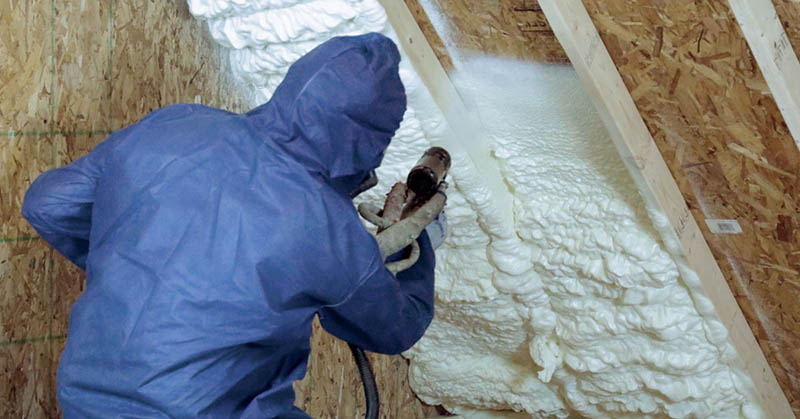
Spray foam insulation is not a cake, obviously, but it is also created through a chemical reaction. When the two liquid components meet at the spray gun, the material reacts, expands, and forms millions of tiny cells before curing into place.
The atmospheric pressure surrounding that reaction changes with elevation. At higher elevations, lower atmospheric pressure can cause some spray foam products to expand more than they would at sea level. If the installer does not use the appropriate product or application method, the finished foam may have a lower density than intended by the manufacturer.
That does not mean spray foam insulation at high altitude is destined to fail. It means the contractor must understand the conditions, follow the manufacturer’s instructions exactly, and verify that the installed foam meets the product’s requirements.
Let’s look at how altitude affects spray foam, why spray foam density matters, and what homeowners should ask before insulating a mountain home.
Key Points
• Altitude can affect spray foam expansion because atmospheric pressure decreases as elevation increases.
• More expansion is not automatically better. Excessive rise can reduce the installed density of some spray foam products.
• Spray foam insulation density is one of the properties manufacturers use when testing and specifying their products.
• Some manufacturers offer high-altitude spray foam insulation blends designed to control density and dimensional stability.
• There is no universal elevation cutoff that applies to every open cell or closed cell spray foam product.
• Open cell foam generally expands more than closed cell foam, but that does not prove that open cell foam is unsuitable for every high-elevation project.
• The product manufacturer should determine whether a high-altitude blend, different settings, or other application changes are required.
• RetroFoam injection foam uses a different material and installation process, so elevation does not affect it in the same way it affects spray polyurethane foam.
Does Altitude Affect Spray Foam?
Yes, altitude can affect spray foam insulation.
As elevation increases, atmospheric pressure decreases. That lower pressure changes the environment in which the gases inside the reacting foam expand.
Depending on the product, spray foam at high elevations may rise more than it would under the higher atmospheric pressure found closer to sea level. That extra rise can increase the amount of space covered by a given amount of material, which installers call yield.
At first, greater yield may sound like a bonus. More foam for the same amount of liquid seems like a pretty good deal.
Unfortunately, spray foam is not judged by how impressively it grows. It is designed and tested to reach specific installed properties, including a target density.
If the foam expands too much, its finished density may fall below the manufacturer’s intended range. That can affect properties such as cell structure, dimensional stability, strength, and thermal performance.
The exact response depends on the spray foam system. That is why a contractor should never assume that a product approved for one elevation will perform exactly the same way at another.
How Does Spray Foam Expansion Work?
Spray polyurethane foam begins as two liquid components, commonly called the A-side and B-side.
Those components travel through heated equipment and hoses before meeting at the spray gun. Once mixed, they create a chemical reaction that produces heat and gas. The gas forms bubbles, the foam rises, and the material cures into its final cellular structure.
Spray foam expansion is influenced by more than altitude. Other important conditions include:
- The temperature of the chemicals
- Ambient air temperature
- Substrate temperature
- Surface moisture
- Equipment temperature and pressure settings
- The ratio of the two components
- Pass thickness
- The specific product formulation
- Installer technique
In other words, elevation is one piece of a larger quality-control puzzle.
An installer working at high altitude still needs to monitor chemical temperatures, substrate conditions, pass thickness, and equipment settings. A high-altitude formula cannot rescue an installation if the chemicals are off-ratio, the surface is unsuitable, or the foam is applied outside the manufacturer’s limits.
What Happens to Spray Foam Expansion at High Altitude?
At higher elevations, there is less atmospheric pressure pushing against the expanding gases within the foam.
For some products, this can lead to an increased rise and lower installed density.
NCFI’s application guide for one of its closed cell products provides a useful real-world example. The manufacturer states that the foam expands more readily above 4,500 feet and recommends a high-altitude blend. According to the guide, the blend is adjusted to prevent the density from dropping too far and to reduce the possibility of dimensional stability problems.
That 4,500-foot recommendation applies to the specific NCFI product covered by the guide. It should not be treated as an industry-wide rule.
Another manufacturer may establish a different threshold, approve its standard formula across a wider range, or provide separate instructions based on elevation and jobsite conditions.
The Insulation Contractors Association of America also advises contractors to consult the spray foam manufacturer for recommendations on high-altitude applications.
The takeaway is simple. The product data and application guide matter more than a general rule found online.
Why Does Spray Foam Insulation Density Matter?
The density of spray foam insulation is the weight of the cured material per unit volume. It is commonly expressed in pounds per cubic foot.
Open cell spray foam is typically a lower-density material, while closed cell spray foam is denser. However, those category names do not replace the specifications for an individual product.
Spray foam density matters because the manufacturer’s reported performance is based on foam installed within its tested and specified range.
Density can influence characteristics such as:
- R-Value and thermal performance
- Compressive and tensile strength
- Cell structure
- Dimensional stability
- Water vapor permeance
- Air-barrier performance at a given thickness
- Product yield
If the foam rises more than intended and becomes too light, it may not match the properties listed on the technical data sheet.
This does not mean that a homeowner can judge spray foam density by touching it or looking at it from across the room. A contractor can cut a sample, measure its volume and weight, and calculate its density when field verification is appropriate.
The result should then be compared with the requirements for the exact product installed.
What Is High-Altitude Spray Foam Insulation?
High-altitude spray foam insulation is a formulation adjusted to perform under the lower atmospheric pressure found at higher elevations.
The goal is not to prevent the foam from expanding. Expansion is a necessary part of how spray foam works.
Instead, the formulation helps control the rise so the cured foam reaches the intended density and other physical properties.
Manufacturers may adjust the foam system to account for elevation, seasonal temperatures, or both. NCFI, for example, has described offering high-altitude and seasonal blends within portions of its spray foam product line.
Contractors should order and install the blend specified for the project conditions. They should not attempt to create their own high-altitude formula by changing chemical ratios outside the manufacturer’s instructions.
Spray foam is normally designed to be processed at a specified ratio. Deliberately spraying off-ratio foam can produce poor-quality material and create serious performance and odor problems.
Is Closed Cell Spray Foam Better at High Altitude?
Closed cell spray foam expands less than open cell foam and cures into a denser, more rigid material.
Those characteristics may make some closed cell products easier to control under certain high-elevation conditions.
However, closed cell spray foam at high altitude is not automatically immune to elevation.
The NCFI product that recommends a high-altitude blend above 4,500 feet is itself a closed cell spray foam. That is a good reminder that density changes can matter for closed cell products too.
Closed cell spray foam may be selected for reasons such as:
- Higher R-Value per inch
- Limited cavity depth
- Vapor-control goals
- Water resistance
- The needs of the specific building assembly
Those are project-design considerations. “The house is in the mountains” is not enough information by itself to determine that closed cell foam is the right choice.
Closed cell foam can add some rigidity to certain assemblies, but it should not be presented as a substitute for structural components designed to resist required wind or snow loads.
Can Open Cell Spray Foam Be Used at High Altitude?
Open cell spray foam generally expands much more than closed cell foam and produces a softer, lower-density material.
Because its installed properties depend on controlled expansion, elevation may be an important consideration. However, it would be too broad to say that open cell spray foam at high altitude always fails or should never be installed.
The contractor needs to verify:
- Whether the exact open cell product is approved for the elevation
- Whether the manufacturer offers a high-altitude formulation
- What ambient and substrate conditions are permitted
- Whether application settings or techniques must change
- Whether open cell foam is appropriate for the climate and assembly
If the manufacturer does not approve the product for the jobsite elevation, the contractor should choose another approved system rather than experimenting in the home.
Can High Elevation Cause Spray Foam to Pull Away or Shrink?
Foam that finishes outside its intended density may be more vulnerable to dimensional stability problems.
That can include unwanted changes in size or shape after installation.
However, elevation is not the only possible reason spray foam pulls away, shrinks, cracks, or looks unusual.
Other causes can include:
- Incorrect chemical temperatures
- An off-ratio mixture
- Applying foam to a surface that is too cold, hot, wet, dirty, or oily
- Applying an excessive thickness in one pass
- Poor mixing
- Equipment problems
- An incompatible or poorly prepared substrate
A contractor should investigate the complete installation rather than blaming every problem on altitude.
Does High Altitude Change Spray Foam R-Value?
Altitude does not automatically erase the R-Value of spray foam.
The concern is whether the installed foam reaches the density and cell structure used to establish the product’s reported performance. If the material is installed outside the manufacturer’s specifications, a contractor should not simply assume it provides the same thermal performance listed on the data sheet.
Homeowners should ask for the product name, technical data sheet, code evaluation report, and applicable high-elevation guidance. Those documents provide a better basis for evaluating performance than a generic claim about R-Value.
Does Elevation Affect RetroFoam Injection Foam?
RetroFoam injection foam is different from two-component spray polyurethane foam.
Spray foam is applied as a liquid to an open cavity, where it reacts and rapidly expands in place. RetroFoam is mixed into a shaving cream-like consistency before it is injected into an enclosed wall cavity.
The material flows around wires, pipes, and existing insulation to fill the available space. It does not depend on the same aggressive in-place expansion that makes atmospheric pressure a significant application consideration for some spray polyurethane foams.
Because the chemistry and installation methods are different, elevation does not affect RetroFoam in the same way.
That does not mean jobsite quality control disappears. A trained installer still needs to prepare the material correctly, monitor its consistency, follow manufacturer instructions, and confirm that each wall cavity is properly filled.
How Do Contractors Install Spray Foam at High Elevations?
A successful high-elevation installation begins before the spray gun is triggered.
A qualified contractor should do the following.
Confirm the Jobsite Elevation
The contractor needs an accurate project elevation so it can be compared with the product manufacturer’s application limits.
Choose an Approved Product and Blend
The contractor should verify whether the standard product is approved or whether a high-altitude spray foam insulation blend is required.
Review Current Manufacturer Instructions
Technical data sheets, application guides, code reports, and written manufacturer guidance should be reviewed for the exact product.
Directions for one spray foam system should not be copied onto another.
Measure Jobsite Conditions
Ambient temperature is not enough.
Installers should also check substrate temperature and other conditions required by the manufacturer.
Set Up and Calibrate the Equipment
Chemical temperature, hose temperature, pressure, and spray technique must remain within the approved processing window.
Control Pass Thickness
Applying too much foam in a single pass can generate excessive heat and damage the material.
High-elevation guidance may also establish product-specific pass limits.
Inspect the Finished Foam
The installer should look for consistent color, texture, adhesion, rise, and coverage.
When needed, field samples can be evaluated for density or other properties.
Contact the Manufacturer When Conditions Are Unclear
Guessing is not a quality-control plan.
If the technical documents do not clearly address the project elevation, the contractor should contact the manufacturer before installation.
Questions to Ask a High-Altitude Spray Foam Contractor
Before hiring a contractor, ask:
- What spray foam product and formulation will you install?
- Is this product approved for my home’s elevation?
- Does the manufacturer require a high-altitude blend here?
- Can I see the technical data sheet and application guide?
- How will you monitor chemical and substrate temperatures?
- How will you verify spray foam density or finished quality?
- What training has your crew completed for this manufacturer’s products?
- What happens if the foam does not rise, adhere, or cure correctly?
- What workmanship and product warranties apply?
- Is open cell or closed cell foam more appropriate for this assembly, and why?
A trustworthy contractor should be able to explain the reasoning behind the recommendation without relying on “That’s how we always do it.”
Choosing Spray Foam for a High-Elevation Home
So, does altitude affect spray foam?
Yes. Lower atmospheric pressure at high altitude can affect spray foam expansion and may cause some products to finish at a lower density than intended.
The solution is not a blanket rule that every mountain home needs closed cell foam. It is choosing a spray foam system approved for the elevation, following the manufacturer’s current application guidance, controlling jobsite conditions, and inspecting the finished material.
Elevation matters, but it is only one part of a successful spray foam installation. Product selection, equipment settings, surface conditions, pass thickness, and installer experience still have leading roles in the story.
To learn more about spray foam, injection foam, insulation performance, and how to choose a qualified contractor, visit our Learning Center.
Related Articles
Low-Pressure vs. High-Pressure Spray Foam: What’s the Difference?
Open Cell vs Closed Cell Spray Foam: What’s the Difference?
What is the Difference Between RetroFoam Injection Foam and Spray Foam Insulation?

Frequently Asked Questions About Spray Foam and Elevation
Does altitude affect spray foam insulation?
Yes.
Lower atmospheric pressure at higher elevations can allow some spray foam products to expand more, potentially lowering their installed density. The effect and required adjustments depend on the exact product.
What happens to spray foam at high elevations?
Some spray foam at high elevations may rise more and produce greater yield than it would near sea level.
If that expansion is not properly controlled, the cured foam may fall outside the manufacturer’s intended density range.
At what elevation do you need high-altitude spray foam?
There is no universal cutoff.
One NCFI application guide recommends a high-altitude blend above 4,500 feet for a specific product, but other manufacturers and products may use different limits. Always follow the guidance for the exact foam being installed.
Does spray foam density affect R-Value?
The density and cell structure of the installed foam are part of the material’s tested performance.
Foam installed outside the manufacturer’s density specification should not automatically be assumed to provide the R-value or other properties listed on its technical data sheet.
Is closed cell spray foam better for high elevations?
Not automatically.
Closed cell foam expands less and is denser than open cell foam, but some closed cell products still require high-altitude formulations.
The appropriate foam depends on manufacturer approval, climate, application, and building-assembly needs.
Can open cell spray foam be installed at high altitude?
Possibly.
The manufacturer must approve the exact open cell product for the project elevation and conditions. A contractor should not assume all open cell foam is prohibited or suitable at high altitude.
Can altitude cause spray foam to shrink or pull away?
Foam installed at an improper density may have dimensional stability problems, but altitude is only one possible factor.
Chemical temperatures, mixture ratio, substrate conditions, pass thickness, equipment, and installer technique should also be investigated.
Is RetroFoam affected by altitude?
RetroFoam injection foam does not rely on the same rapid in-place expansion as spray foam, so elevation does not affect it in the same way.
Installers must still follow the manufacturer’s preparation and installation instructions.