

If you are researching insulation and keep seeing cellulose pop up, you may wonder if this old-school insulation still holds up.
Cellulose insulation has been around for decades and is still used in homes across the country. It is affordable, made from recycled materials, and widely available. But like any insulation product, it comes with strengths and tradeoffs.
If you are comparing options, here is what you need to know about cellulose insulation, how blown-in cellulose insulation works, and whether it makes sense for your home.
Key Points: Cellulose Insulation
• Cellulose insulation is a fiber-based material made mostly from recycled paper or denim.
• Blown-in cellulose insulation is commonly installed in attics and wall cavities.
• The R-Value of cellulose falls between R-3.1 and R-3.8 per inch.
• It slows heat transfer but does not stop air movement.
• It can settle up to 20 percent over time.
• It can absorb significant moisture if exposed to water.
• Chemical treatments improve resistance to fire, pests, and mold.
• Installation quality plays a major role in performance.
What is Cellulose Insulation?
So what is cellulose insulation exactly?
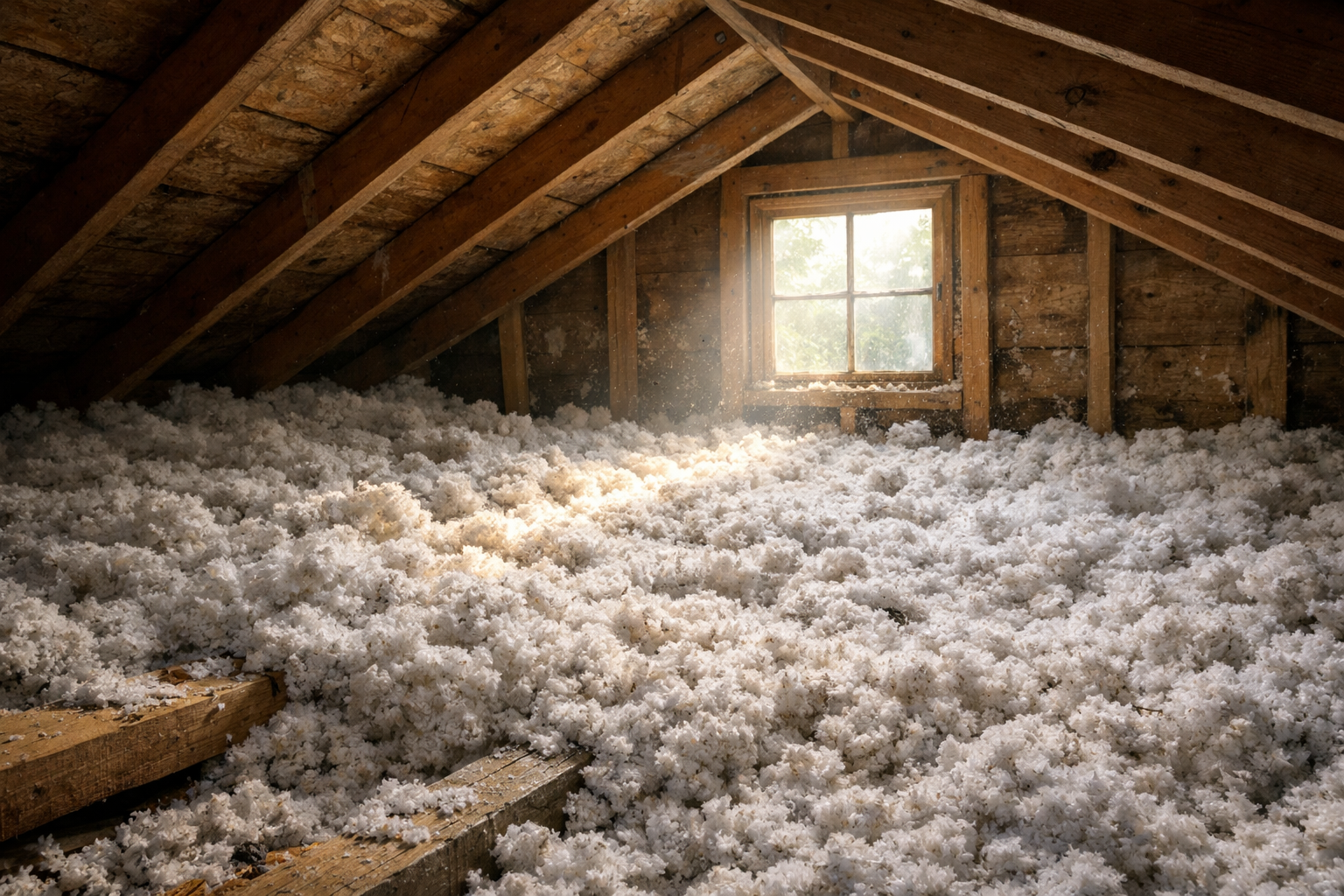
Cellulose insulation is a fiber-based insulation material that is typically installed with a blowing machine. It is most often used in:
- Existing wall cavities
- Attic floors
- Floors between levels
- New construction wall systems
When homeowners refer to cellulose blown-in insulation, they’re talking about this installation method where loose fibers are blown into a cavity to fill it completely.
Cellulose became especially popular in the 1950s when manufacturers began adding fire-retardant treatments. That added a level of safety and comfort that other insulation options at the time did not offer.
What is Cellulose Insulation Made Of?
One of the most common questions homeowners ask is, what is cellulose insulation made of?
Cellulose insulation is typically composed of about 75 to 85 percent recycled newspaper or denim. The remaining portion consists of chemical treatments.
If you’re wondering what is in cellulose insulation, those additives are included to improve:
- Fire resistance
- Pest deterrence
- Mold resistance
In some new construction applications, moisture is added during installation to help the material adhere to the inside of open wall cavities before drywall is installed.
Is Cellulose Insulation Safe?
Another common question is simple: Is cellulose insulation safe?
Generally speaking, yes – when it is properly installed and kept dry.
The fire-retardant treatments are specifically designed to improve safety. However, performance can change under certain conditions.
If cellulose becomes saturated with water, it can:
- Lose insulating effectiveness
- Dry very slowly
- Lose some fire-resistant properties
Dust during installation can also create a mess if containment is not handled properly. As with any insulation material, safety and performance depend heavily on correct installation and proper moisture management.
Types of Blown-In Cellulose Insulation Applications
There are three primary ways in which blown-in cellulose insulation is installed.
Loose Fill for Attics
Loose-fill cellulose is blown across the attic floor and then raked to ensure full, even coverage.
This is one of the most common applications.
Dense Pack for Walls and Floors
Dense-pack cellulose is blown into enclosed wall cavities or floor systems under pressure.
Dense packing improves performance compared to loose fill, but it still allows some air movement.
Wet Spray for New Construction
In new construction, cellulose can be dampened and sprayed into open wall cavities before drywall is installed.
The added moisture helps it stick in place during installation.
Cellulose Insulation Performance
Cellulose provides thermal insulation and can offer some sound-dampening benefits.
But there are some limitations.
The R-Value of Cellulose
The R-Value of cellulose insulation typically falls between R-3.1 and R-3.8 per inch.
That number only measures resistance to heat flow. It does not measure resistance to air movement, and that matters.
Air leakage can account for up to 40 percent of a home’s energy loss. If insulation slows heat but still allows air to move through it, comfort and efficiency suffer.
Choosing insulation based solely on R-Value can be misleading.
Pros of Cellulose Insulation
Cellulose insulation offers several advantages.
- It is made from recycled materials, which appeals to environmentally conscious homeowners.
- It does not rely on greenhouse gas propellants.
- It conforms well to irregular spaces when first installed.
- Chemical treatments provide fire, pest, and mold resistance.
- It is generally less expensive than many alternative insulation materials.
- In some cases, experienced homeowners may install loose-fill cellulose in attics themselves.
Cons of Cellulose Insulation
There are also important drawbacks of cellulose insulation to consider.
- Modern cellulose can settle up to 20 percent over time. In walls, this can create gaps at the top of cavities; in attics, settling reduces overall depth and R-Value.
- Cellulose can absorb up to 130 percent of its weight in water. When wet, it dries slowly and loses performance.
- Even when dense-packed, cellulose does not create an air seal. That means drafts can still occur, and HVAC systems may work harder to maintain temperature.
- Cellulose can be dusty and messy. In some dense-pack installations, fine dust can circulate through ductwork if proper precautions are not taken.
- Cellulose weighs more than fiberglass insulation. In certain attic applications, especially on slopes or in older structures, that added weight can be a concern.
Blown-In Cellulose Installation Process
If you are considering cellulose blown-in insulation, here’s what installation typically involves.
Wall Installation
- Siding is removed
- Holes are drilled into each wall cavity
- The cellulose is blown in
- The holes are sealed, and the siding is replaced
Attic Installation
- Cellulose is blown across the attic floor
- Installers rake it to ensure even coverage
- They also measure the depth to make sure it meets R-Value
New Construction
- Cellulose is installed behind netting or damp-sprayed before drywall is installed
- Performance depends heavily on installation quality
How Does Cellulose Insulation Affect Energy Costs?
Heating and cooling account for roughly 50 to 70 percent of household energy use.
Cellulose helps reduce heat transfer, but it struggles with airflow control. If air continues to move through the insulation, your HVAC system may have to work harder to maintain comfort.
Over time, settling and moisture exposure can further reduce effectiveness.
Understanding how heat, air, and moisture move through your home is the key to making a smart insulation decision.
Cellulose Insulation as an Option for Your Home
Cellulose insulation is affordable, widely used, and made from recycled materials.
It can improve thermal performance and provide sound dampening.
However, it settles, absorbs moisture, and does not stop air movement.
The best insulation decision is not just about R-Value – it is about understanding how heat, air, and moisture interact inside your home. When you look at the full building science picture, you can choose a solution that supports long-term comfort and efficiency.
If you want to learn more about insulation and building science, explore the additional resources in our Learning Center.
Related Articles
What are the Best Exterior Wall Insulation Options?

Frequently Asked Questions About Cellulose Insulation
What is cellulose insulation?
Cellulose insulation is a fiber-based insulation made primarily from recycled paper products and treated for fire, pest, and mold resistance.
It is commonly installed as blown-in insulation.
What is cellulose insulation made of?
It is typically made of 75 to 85 percent recycled newspaper or denim and about 15 percent chemical treatments.
Is cellulose insulation safe?
Yes, when properly installed and kept dry.
Moisture exposure can reduce its effectiveness and fire resistance.
What is the R-Value of cellulose insulation?
Cellulose insulation has an R-Value between R-3.1 and R-3.8 per inch.
Does blown-in cellulose insulation stop air leaks?
No.
It slows heat transfer but does not fully prevent air movement.
Does cellulose insulation settle over time?
Yes.
It can settle up to 20 percent, which may reduce performance.