

If your home has insulation, chances are it’s fiberglass insulation.
It’s been used in homes since the 1930s and is still common in new construction today.
But what is fiberglass insulation, how does it actually perform, and is fiberglass insulation safe for your home?
If you’re considering fiberglass batt insulation or blown-in fiberglass insulation for your project, let’s break down what it’s made of, how it works, where it performs well, and where it can fall short.
Key Points About Fiberglass Insulation
• Fiberglass insulation is made of extremely fine glass fibers.
• It comes in fiberglass batt insulation, rolls, rigid boards, and blown-in fiberglass insulation.
• It slows heat transfer by trapping air in tiny pockets.
• R-Value measures resistance to heat flow, but it does not account for air leakage.
• Air leakage can account for up to 40 percent of energy loss in a home.
• Fiberglass is affordable and DIY-friendly.
• It can cause skin irritation and respiratory issues when disturbed.
• Installation quality greatly impacts performance.
What is Fiberglass Insulation?
So, what is fiberglass insulation exactly?
Fiberglass insulation is made of extremely fine glass fibers. During manufacturing, molten glass is spun into strands, then coated with a binder and formed into different products.
You’ll most commonly see:
- Fiberglass batt insulation (pre-cut panels)
- Rolls of fiberglass insulation
- Blown-in fiberglass insulation, also known as loose-fill
- Rigid fiberglass boards
- Duct insulation
It’s lightweight, widely available, and designed to resist heat transfer in homes across the country.
What is Fiberglass Insulation Made Of?
If you’ve ever wondered what fiberglass insulation is made of, here’s the simple version:
- Recycled glass and sand are melted at high temperatures.
- The molten material is spun into fine fibers.
- A binder holds the fibers together in batts and rolls.
- The product is shaped into batts or prepared as loose-fill for blowing.
The result is a fibrous material designed to slow the movement of heat.
How Does Fiberglass Insulation Work?
Fiberglass insulation works by trapping small pockets of air within its fibers.
Those air pockets slow down heat transfer.
In simple terms:
- It slows heat from leaving your home in winter.
- It slows heat from entering your home in summer.
- It also helps reduce sound transfer between rooms.
But here’s the important detail.
Fiberglass slows air movement. It does not completely stop it.
If air can move through the insulation, comfort and efficiency are already compromised. This is why insulation performance is about more than just R-Value.
Understanding R-Value and Fiberglass
You’ve probably heard that fiberglass insulation has a “high R-Value.”
R-Value measures resistance to heat flow. The higher the number, the greater the resistance.
In colder climates, higher R-Values are typically recommended. Fiberglass is flexible and can be layered to reach the target R-Values in attics and walls. This stacking is why it’s perceived that fiberglass has a higher R-Value, when in actuality the per-inch R-Value is around R-2.9 and R-3.8 for batts and R-2.2 and R-2.9 for loose-fill.
Another thing to keep in mind is that R-Value doesn’t measure air leakage.
Air leakage can account for up to 40 percent of energy loss in a home. If air is moving through gaps, cracks, and penetrations, your insulation’s labeled R-Value doesn’t tell the full story.
Insulation performance depends on how well it controls:
- Heat
- Air
- Moisture
Not just a number on the packaging.
Check out this article with a chart that shows the highest R-Value insulations.
Where is Fiberglass Insulation Installed?
Fiberglass insulation can be installed in many areas of the home, including:
- Exterior walls
- Attics
- Ceilings
- Floors
- Crawl spaces
- Rim joists
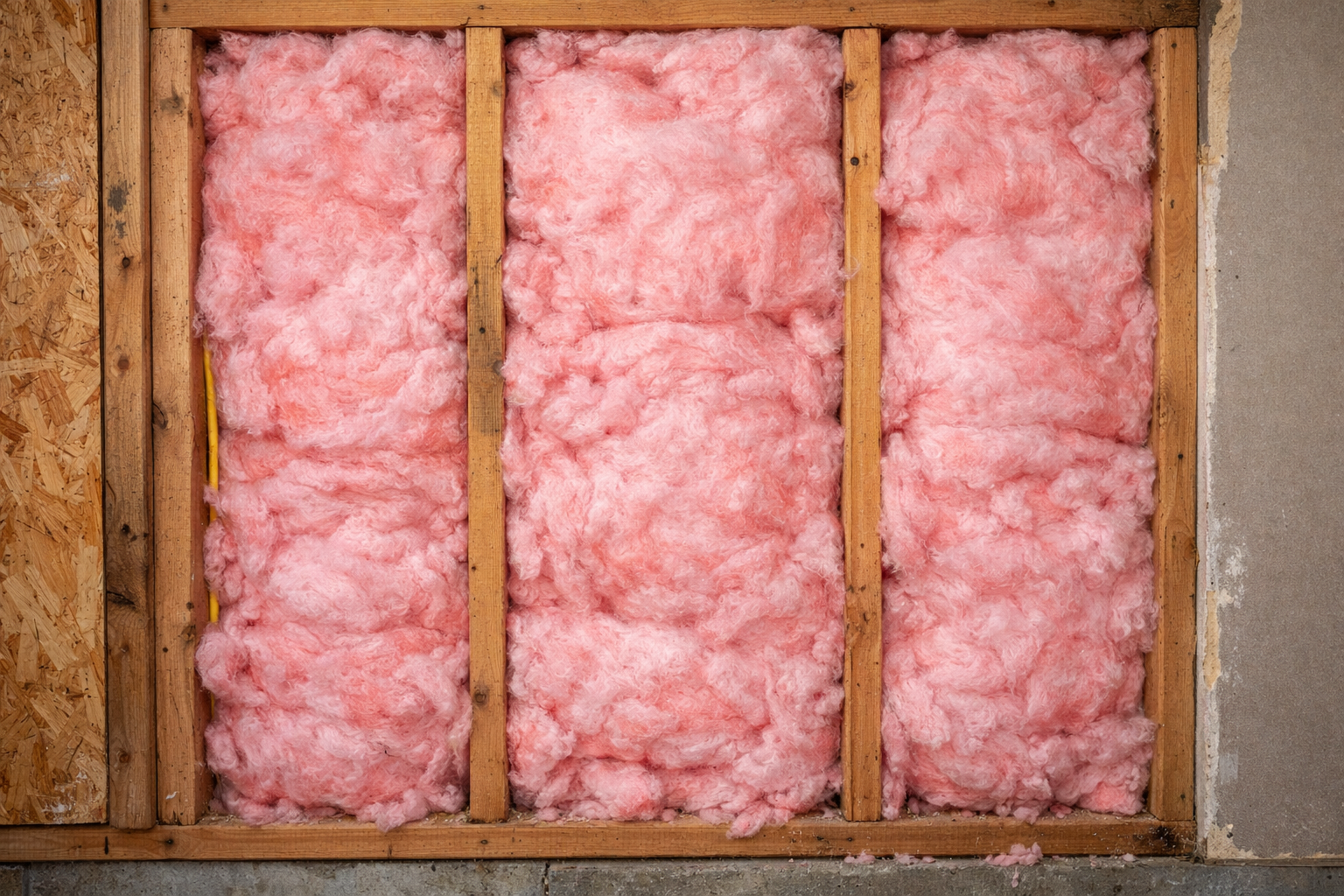
Fiberglass batt insulation is typically installed between studs and joists. Blown-in fiberglass insulation is often used in attics or dense-packed into wall cavities.
Because it fits standard framing spacing and is widely available, it’s a common choice in both new construction and remodeling projects.
Fiberglass Batt Insulation vs. Blown-In Fiberglass Insulation
While both batts and blown-in are fiberglass insulation, the way they are installed and aspects of the way they work are slightly different.
Let’s take a moment to discuss the pros and cons of fiberglass batts and blown-in insulation.
What is Fiberglass Batt Insulation?
Fiberglass batt insulation comes in pre-cut panels designed to fit between wall studs and ceiling joists.
It is often stapled into place and may include a paper or foil facing that acts as a vapor retarder.
Fiberglass Batt Insulation Pros:
- Easy to find at home improvement stores
- DIY-friendly
- Affordable
- Simple installation in open framing
Fiberglass Batt Insulation Cons:
- Must be cut precisely
- Can leave gaps if not installed tightly
- Compression reduces performance
- The vapor retarder must face the correct side
What is Blown-In Fiberglass Insulation?
Blown-in fiberglass insulation is a loose-fill material installed with a blowing machine.
It is commonly used in:
- Attics
- Existing wall cavities
- Hard-to-reach spaces
Blown-In Fiberglass Insulation Pros:
- Good for filling irregular spaces
- Can cover large attic areas quickly
Blown-In Fiberglass Insulation Cons:
- Still allows air movement
- Can settle over time
- Requires equipment for proper installation
Pros of Fiberglass Insulation
Fiberglass remains popular for several reasons:
- Lower upfront cost
- Widely available
- Familiar to contractors and homeowners
- Works well in standard framing
- DIY installation is possible
For homeowners focused on budget and accessibility, fiberglass insulation is often the first option considered.
Cons of Fiberglass Insulation
It’s just as important to talk about the limitations of fiberglass insulation, and we’re going to tackle these a little more in-depth.
Air Leakage
Fiberglass slows heat, but it does not create an air seal.
Air can still move through it, leading to drafts and reduced energy efficiency.
Moisture Concerns
Fiberglass can trap moisture.
When it gets wet, its insulating ability drops. Persistent moisture can increase the risk of mold growth.
Installation Sensitivity
Fiberglass must be installed perfectly to perform well.
Common problems include:
- Gaps around outlets and pipes
- Compression inside cavities
- Misaligned vapor barriers
- Poor cutting around obstructions
Even good insulation performs poorly when installed incorrectly.
Is Fiberglass Insulation Safe?
Many homeowners ask: Is fiberglass insulation safe?
Fiberglass insulation can cause some serious issues when handled or disturbed, including:
- Skin irritation and itchiness may occur if handled without protection
- Eye irritation
- Respiratory discomfort if fibers become airborne during installation or disturbance
Modern fiberglass products are generally considered safe when properly installed and left undisturbed. However, protective clothing, gloves, and masks are recommended during handling.
If insulation becomes damaged, wet, or exposed, it may need to be evaluated and replaced.
How to Cut Fiberglass Insulation
We just talked specifically about the safety of fiberglass, and what that really comes down to is how to handle it.
If you’re installing fiberglass batt insulation yourself, here’s what you need to know about how to cut it safely.
Basic steps include:
- Wear gloves, long sleeves, eye protection, and a mask.
- Use a straight edge as a guide.
- Cut with a sharp utility knife.
- Measure carefully to avoid gaps or compression.
- Ensure the batt fits snugly without being forced into place.
Precision matters. Gaps reduce performance, and compression lowers the effective R-Value.
How Fiberglass Affects Energy Costs
Fiberglass insulation resists heat transfer, which can help lower energy costs.
However, poor air control can force your HVAC system to work harder. That can result in:
- Higher utility bills
- Uneven temperatures
- Drafty rooms
- Reduced comfort
If insulation is installed without proper air sealing, the system may never perform as efficiently as expected.
Is Fiberglass the Right Choice for Your Home?
Fiberglass insulation has been a staple in homes for nearly a century.
It’s affordable and accessible, but performance depends heavily on installation quality and air control.
Fiberglass Insulation is:
- Affordable
- Widely used
- Familiar
- Readily available
But it also:
- Allows air movement
- Can trap moisture
- Depends heavily on installation quality
The best insulation choice isn’t just about cost. It’s about how well the material controls heat, air, and moisture together.
If you want to learn more about insulation, energy efficiency, and building science basics, explore our Learning Center for more in-depth articles and videos.
Related Articles
Foam Insulation vs. Fiberglass: A Comprehensive Comparison to Coffee Cups
What is Flash and Batt Insulation? Pros, Cons, and Common Problems Explained

Frequently Asked Questions About Fiberglass Insulation
What is fiberglass insulation?
Fiberglass insulation is a fibrous material made from spun molten glass designed to resist heat transfer in walls, attics, and floors.
What is fiberglass insulation made of?
It is made from melted glass spun into fine fibers, often using recycled materials, and formed into batts or loose-fill products.
What is fiberglass batt insulation?
Fiberglass batt insulation is pre-cut panels designed to fit between wall studs and ceiling joists.
What is blown-in fiberglass insulation?
Blown-in fiberglass insulation is a loose-fill material installed using specialized equipment, commonly used in attics and enclosed cavities.
Is fiberglass insulation safe?
It is generally safe when properly installed, but it can cause skin and respiratory irritation during handling.
Does fiberglass insulation stop air leaks?
No.
Fiberglass slows heat transfer but does not fully stop air movement.